What is the F1 Student Visa?
The F1 is a non‑immigrant visa for full‑time study at a SEVP‑approved U.S. college, university, school or language institute. It permits on‑campus work (generally up to 20 hours per week during term) and practical training options like CPT and OPT after meeting eligibility criteria.
PFEC India students typically require this visa for bachelor’s, master’s, PhD, community college, and many English-language programs in the U.S.
Key Eligibility Requirements
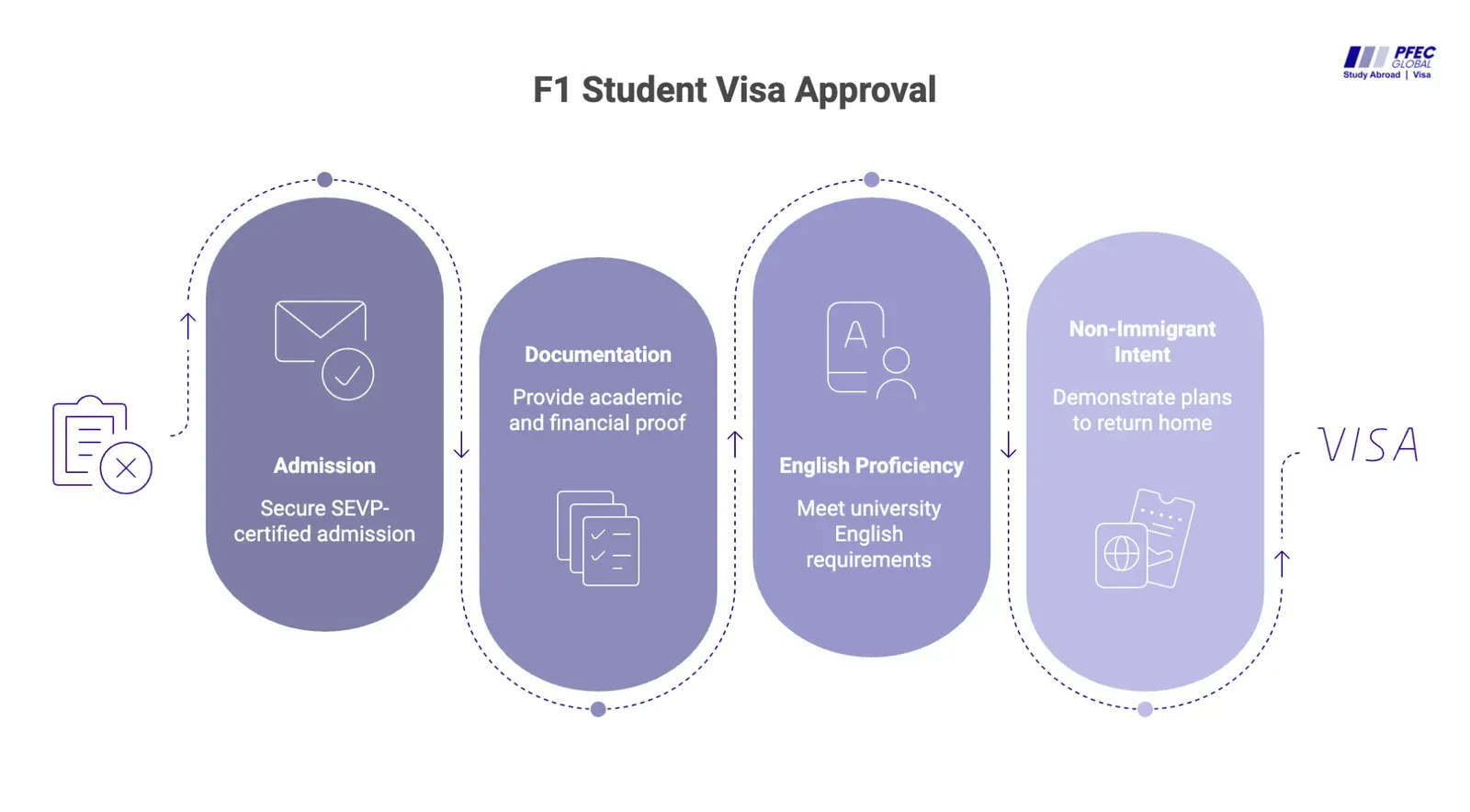
To qualify, you must secure admission to a SEVP-certified U.S. institution and receive a Form I-20. You also need to demonstrate academic preparedness through transcripts and test scores, and meet your university’s English proficiency requirements, usually via IELTS, TOEFL, or an equivalent test.
F1 applicants must also show non-immigrant intent, with clear plans to return home, and provide proof of funds to cover at least the first year’s tuition and living expenses. Consistent documentation and genuine study goals improve your chances of visa approval.

Financial Proof for F1 Visa
U.S. consulates require proof that you can fund your studies without relying on unauthorized work. Students must typically show liquid funds covering at least one year of total costs, including the I-20 tuition amount and estimated living expenses, usually ranging from USD 20,000 to 40,000 or more, depending on the university and location.
Acceptable evidence includes recent bank statements (from the last 3 to 6 months), education loan sanction letters, fixed deposits, sponsor affidavits, income proofs, and scholarship or assistantship letters, if applicable. Funds must be traceable, from reputable banks, and consistent with your I-20 and financial forms.
Step‑by‑Step Application Process
The F1 process begins by selecting SEVP-approved institutions, applying, and securing admission from at least one university. After admission, your institution issues Form I-20, which includes your SEVIS ID, program details, and estimated costs for your visa application.
Next, pay the SEVIS I-901 fee (currently USD 350 for F1) and complete Form DS-160, the online non-immigrant visa application. After paying the MRV visa fee, around USD 185, schedule your visa interview at the U.S. Embassy or Consulate in India. Bring your passport, I-20, DS-160 confirmation, fee receipts, academic records, and financial documents to the interview.
F1 Visa Interview Tips
Visa officers primarily assess three aspects: academic intent, financial capaVisa officers assess academic intent, financial capacity, and ties to your home country. Clear, confident answers about your course selection, university choice, funding plan, and post-study goals help demonstrate your genuine intent to study and return.n present any record quickly when asked. Avoid memorised or contradictory answers; officers prefer concise, honest explanations that match your documents and application.
Working and Staying in the U.S. on F1
With F1 status, you may work part-time on campus, generally up to 20 hours per week during semesters and more during breaks, if permitted by your school. Off-campus work is limited to authorized options such as Curricular Practical Training (CPT) during your program and Optional Practical Training (OPT) after meeting eligibility requirements.
Many students use up to 12 months of OPT after graduation. STEM graduates may qualify for an additional 24-month STEM OPT extension, subject to current federal guidelines. Coordinate all work and status-related actions with your Designated School Official (DSO) to maintain compliance.
Recent Updates and 2025 Considerations
In 2025, there is greater emphasis on security checks, enhanced biometrics, and thorough review of SEVIS records and financial documents. Fee levels, including SEVIS and some consular fees, have changed. Always confirm current amounts on official U.S. government or university international office websites before making payments.
There is also closer scrutiny of maintaining status, including accurate program end dates, timely OPT filings, and address updates. It is crucial to follow university guidance and SEVIS rules throughout your stay.
How PFEC India Can Help
PFEC’s USA visa guides emphasize the importance of accurate documentation and strong financial evidence for successful visa outcomes. PFEC India counsellors can help you shortlist SEVP-approved universities, review your financial plan, prepare visa documentation, and practice mock interviews tailored to Indian students.
If you plan to apply for the F1 visa, booking a personalized counselling session with PFEC India helps you align your admission timeline, visa filing, and travel plans to ensure you arrive in the U.S. before your program start date.
Frequently Asked Questions (FAQ)
1. What is an F-1 student visa and who needs it?
The F-1 visa is a non-immigrant visa for international students who want to study full-time at a SEVP-approved institution in the USA. It is required for most academic programs, including universities, colleges, and language courses.
2. What are the main steps to apply for an F-1 student visa?
The F-1 visa process includes getting admission and I-20, paying the SEVIS fee, filling the DS-160 form, paying the visa fee, and attending the embassy interview.
3. What documents are required for an F-1 visa interview?
Key documents include your passport, Form I-20, SEVIS fee receipt, DS-160 confirmation, visa appointment letter, academic records, and proof of financial support.
4. Can international students work on an F-1 visa?
Yes, students can work up to 20 hours per week on-campus during study periods and full-time during breaks. They may also be eligible for CPT and OPT for work experience.
5. What are the common reasons for F-1 visa rejection?
Common reasons include insufficient financial proof, weak academic intent, lack of clarity about future plans, and failure to demonstrate ties to the home country.