Post-Graduate Work Permit Explained: Canada PGWP Guide for Indian Students (2026)
- Priyam Ghosh
- 8 min Read
The Post-Graduate Work Permit Canada (PGWP) allows Indian students to work in Canada after completing eligible study programs. This 2026 guide explains PGWP eligibility, duration, fees, and recent rule changes, including language requirements and field-of-study conditions. Students must ensure their institution and program qualify, as not all courses are eligible. With a validity of up to 3 years, the PGWP helps build Canadian work experience and supports long-term immigration goals. Proper planning and course selection are essential to maximise post-study opportunities.
Canada remains one of the most attractive destinations for Indian students because it offers more than a degree. It offers a pathway to gain Canadian work experience after graduation, which can strengthen long-term career prospects and, in many cases, support future immigration plans. That is where the Post-Graduation Work Permit, commonly called the PGWP, becomes important.
If you are planning to study in Canada, you should understand the PGWP before you even choose your college or university. Not every institution qualifies. Not every program qualifies. And recent rule changes mean students need to pay much closer attention to eligibility, language requirements, and field-of-study rules
What Is a Post-Graduation Work Permit?
A Post-Graduation Work Permit is an open work permit that allows eligible international graduates to live and work in Canada after finishing a qualifying program at a PGWP-eligible designated learning institution. Because it is an open work permit, you are generally not tied to one employer, which gives graduates flexibility to work across roles, industries, and locations in Canada. The Canadian government also states that the work experience gained through a PGWP may help graduates qualify for permanent residence.
This is why the PGWP matters so much to Indian students. It does not just help you earn after graduation. It can become a bridge between study and a longer-term career in Canada.
Why the PGWP Matters for Indian Students
For many Indian students, Canada is attractive because the study journey does not have to end at graduation. A PGWP can give you time to:
- build Canadian work experience,
- improve your employability in the local market,
- strengthen eligibility for immigration pathways, and
- recover part of your education investment through post-study employment.
That said, students should avoid assuming that every Canadian course automatically leads to a PGWP. The Canadian government is explicit that graduating from a designated learning institution does not automatically make you eligible. The institution and the specific program both matter.
Who Can Apply for a PGWP?
To qualify for a PGWP, you must meet the general eligibility requirements set by Immigration, Refugees and Citizenship Canada. In broad terms, you must have completed a study program at a PGWP-eligible designated learning institution, and the program must have been at least 8 months long or 900 hours for Quebec programs. You also generally need to have maintained full-time status during each semester of your program, although part-time study in the final semester is permitted.
You also need to apply within 180 days of graduating. Canada’s official guidance confirms that you can apply from inside Canada or from another country, as long as you meet the eligibility criteria.

The Big 2026 Point: New Rules Still Matter
One of the most important things Indian students need to know is that the PGWP system changed for many applicants from November 1, 2024 onward. Most PGWP applicants now need to provide proof of language ability when applying. Canada’s official PGWP guidance makes that clear, and the documents page confirms that language proof is required for applications submitted on or after that date, where applicable.
There is also a field-of-study requirement for some students. Canada states that for non-degree programs—that is, programs other than bachelor’s, master’s, or doctoral degrees—graduates must complete a program in an eligible field linked to occupations in long-term shortage. The government updated this rule in 2025 and maintains an official list of eligible CIP codes.
This means that students considering diplomas or other non-degree pathways should be especially careful. A cheaper or shorter program may look attractive upfront, but if it does not meet PGWP rules, it could affect your post-study options.
PGWP Eligibility at a Glance
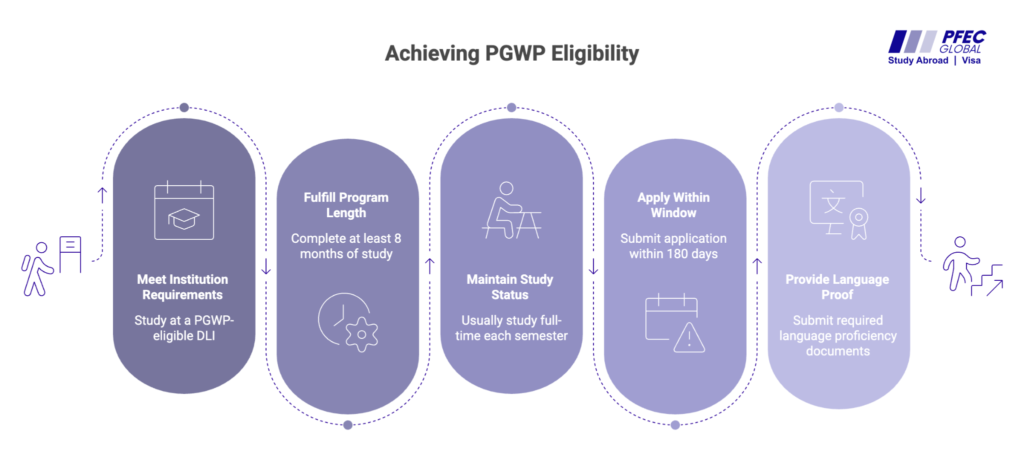
Here is a simple comparison table for publication use:
|
Requirement |
What You Need to Know |
|
Institution |
Must be a PGWP-eligible designated learning institution |
|
Program length |
At least 8 months long, or 900 hours in Quebec |
|
Study status |
Must usually maintain full-time status in each semester; part-time may be allowed in the final semester |
|
Application window |
Must apply within 180 days of completing your program |
|
Language proof |
Required for most applicants under the newer rules |
|
Field of study |
May apply to non-degree programs such as diplomas |
|
Automatic eligibility |
No — studying at a DLI alone does not guarantee a PGWP |
This summary is based on the latest official IRCC guidance.
How Long Is the PGWP Valid?
The PGWP may be valid from 8 months up to 3 years. The exact validity depends on the level and duration of the study program, and in some cases, your passport expiry date can shorten the permit. Canada’s Help Centre confirms the 8-month to 3-year range, while the official PGWP page notes that passport validity can also affect the final length issued.
A practical way to think about it is this:
|
Study Program |
Possible PGWP Outcome |
|
Program shorter than 8 months |
Usually not eligible |
|
Program of at least 8 months |
May qualify |
|
Longer eligible programs |
Can lead to longer PGWP validity |
|
Maximum possible |
Up to 3 years |
Students should avoid relying on informal forum advice here. The exact permit length is determined by official rules and your individual circumstances.
What Documents Are Usually Required?
Canada’s PGWP document guidance states that applicants need proof they completed their studies and proof they were enrolled in full-time studies in a program that was at least 8 months long. For applications affected by the new rules, you may also need to provide proof of language ability and, where applicable, proof that your program was in an eligible field of study. Medical exam documents may also be required in some cases.
In practical terms, students should be prepared with:
- your completion letter or transcript,
- proof of program length and enrollment,
- language test results if required,
- field-of-study proof if required, and
- any additional documents requested by IRCC.
How Much Does a PGWP Cost?
The Canadian government’s Help Centre states that the PGWP fee is CAD 155, plus the CAD 100 open work permit holder fee, bringing the standard total to CAD 255.
Students should also factor in possible additional costs such as biometrics, medical exams if applicable, and document preparation expenses. Those extra costs vary by case, but the base PGWP fee itself is clearly stated by IRCC.
Can You Work While Waiting for the PGWP Decision?
In many cases, yes. Canada states that you can work full-time while waiting for a decision on your PGWP application if, at the time you submitted the application, you had a valid study permit, had completed your study program, were eligible to work off campus without a permit while studying, and did not work more hours than allowed during your studies.
That is a major advantage for graduates because it can reduce the gap between study completion and employment. However, students should not assume this applies automatically in every situation. Your status at the time of application matters.
Important Travel and Application Rule
Another detail that Indian students often miss is that, as of June 21, 2024, Canada no longer allows PGWP applications at a port of entry. IRCC’s official Help Centre says you must apply before coming to Canada or after entering Canada as a visitor, if eligible, but not at the border itself.
This matters for planning. If you graduate, travel, and try to manage your PGWP casually while re-entering, you could run into avoidable issues.
Degree vs Diploma: Why This Choice Matters More Now
This is one of the most important strategic decisions for Indian students. Canada’s official updates show that bachelor’s, master’s, and doctoral degree graduates are treated differently from non-degree program graduates when it comes to field-of-study requirements. Non-degree graduates may need to prove their program is in an eligible field linked to long-term labour shortages.
In practical terms, that means students choosing a diploma purely because it is cheaper or faster should pause and assess whether the program supports PGWP eligibility under the current rules. A well-known city or college brand is not enough. The program itself matters.
Common Mistakes Students Should Avoid
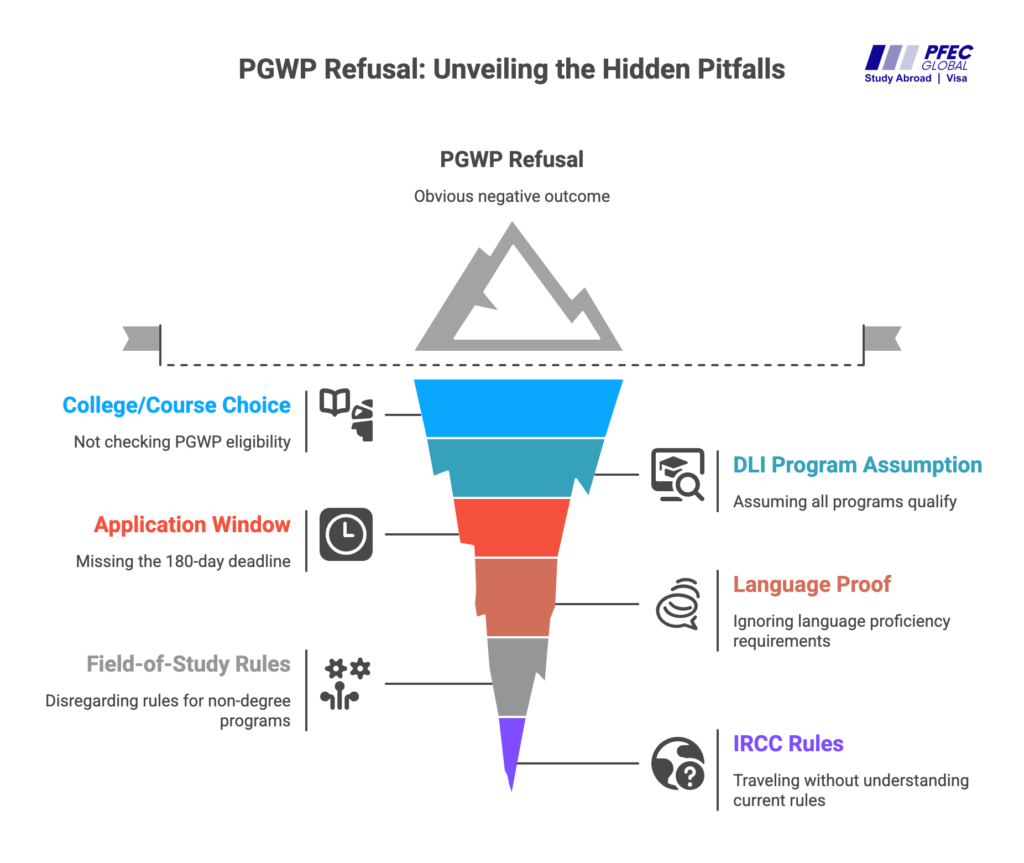
A PGWP refusal can have long-term consequences, so students should avoid common mistakes such as:
- choosing a college or course without checking PGWP eligibility,
- assuming every DLI program qualifies,
- missing the 180-day application window,
- ignoring language proof requirements,
- ignoring field-of-study rules for non-degree programs, and
- traveling or making application decisions without understanding current IRCC rules.
How the PGWP Supports Long-Term Plans
The PGWP is valuable because it gives graduates time to gain Canadian work experience, and IRCC explicitly notes that such work experience may help with permanent residence pathways. For Indian students thinking beyond the classroom, that makes the PGWP one of the strongest reasons to study in Canada—provided the course selection is done correctly from the beginning.
Final Thoughts
If you want to study in Canada and work after graduation, you should treat the PGWP as part of your course-selection strategy, not as an afterthought. The right program at the right institution can open the door to post-study work and long-term career opportunities. The wrong choice can limit your options, even if you complete your studies successfully.
For Indian students, the smartest approach is to evaluate four things before applying:
- the institution’s PGWP eligibility,
- the exact program type,
- whether language proof will be required, and
- whether field-of-study rules apply to that course.
At PFEC Global India, this is exactly where good counselling makes a difference. A strong Canada plan is not just about getting admission. It is about choosing a study pathway that protects your post-study work options as well.
Frequently Asked Questions (FAQ)
1. What is a Post-Graduate Work Permit (PGWP) in Canada?
A PGWP is an open work permit that allows international students to work in Canada after completing an eligible study program.
2. How long is the PGWP valid in Canada?
The PGWP can be valid from 8 months up to 3 years, depending on the length and type of your study program.
3. Who is eligible for a PGWP in Canada?
Students must graduate from a PGWP-eligible designated learning institution and complete a program of at least 8 months.
4. Is language proof required for PGWP in 2026?
Yes, many applicants must provide language test results under rules introduced from November 2024 onward.
5. Can diploma students get a PGWP in Canada?
Yes, but diploma programs must meet field-of-study requirements linked to labour market demand.

Take your Study Abroad Dreams to the Next Level
Receive free end-to-end assistance and personalized guidance from experts
Get Started for FREE →